Workshop in Egypt: Democracies in the Making. Egypt at the centre of Arab Transitions

Are the Arab transitions failing? Will the countries of the region be able to consolidate inclusive democratic systems? Is the European Union doing enough to support democratic reforms and civil society? What is the role that think-tanks can play in countries in transition? Can they provide transforming ideas and become an informed and independent voice in policy debates?

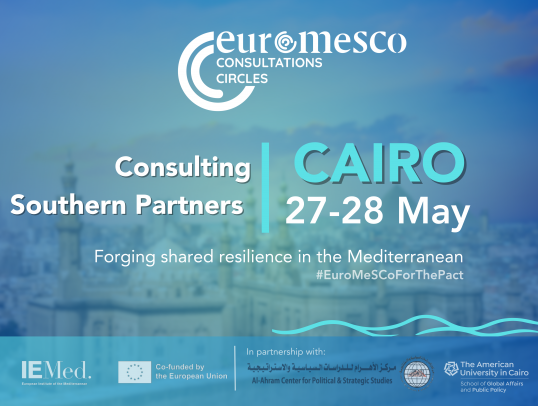
The objective of this workshop to be held in Cairo, Egypt on 3-4 June 2013, is to analyse the current phase of the democratic transitions in the region dominated by a high level of polarisation. The workshop will be an opportunity to collectively engage with the main think-tanks and identify the critical choices that policy makers are facing, and to analyse the actors and the factors at play, with a particular focus on Egypt and its significance for the rest of democratic transitions in the Arab world.

The sessions on 3 June  will be open to the public, while the ones on 4 June are by invitation only

See the programme of the workshop here:

 
Second Symposium on Security in the Mediterranean, Tunisia

EuroMeSCo will participate in the organisation of the Second Symposium on Security in the Mediterranean, to be held in Tunis on 2 and 3 May 2013 and organised by the Centre d’Études Méditerranéennes et Internationales (CEMI) in collaboration with the Ministry of Defence of Tunisia and the support of the Konrad Adenauer Foundation. The meeting will focus on four main areas: Deepening of the various dialogues on security in the Mediterranean, cooperation on security in the western basin of the Mediterranean, threats to security in the Mediterranean region and terrorism and counter-terrorism. Participation to this workshop is by invitation only.

See the programme here

 
EuroMeSCo Paper 17: The European Union and the Arab World: from the Rome Treaty to the Arab Spring


For many Europeans, the Arab World is seen, at best, as an oil well and a huge market and, at worst, as a turbulent and dangerous environment. Thus, access to oil, market penetration and security interests have largely driven European policies towards this region.


This paper by Bichara Khader analyses the objectives of the European policies towards the Mediterranean in the past 65 years. It underlines how objectives such as conflict resolution, human rights and democracy promotion have often been mentioned in the EU official documents but that the discrepancy between rhetoric and deeds has been appalling. According to the author, Arab Civil society was not taken seriously as a partner in dialogue, which explains why the Arab Spring caught the EU off guard.


The EU has yet taken note of the developments unfolding in many Arab countries and forced to respond urgently to the new challenges. This paper by Bichara Khader is an attempt to shed some light on past European relations with the Arab World and to critically assess the European response to the regional situation following the Arab Spring. Its main findings were presented at the EuroMeSCo Annual Conference 2012: “Europe, the Mediterranean and the Arab Spring: Crisis as an Opportunity”.


Read full text


EuroMeSCo Paper 18: The End of the (Southern) Neighbourhood


After decades of relative stagnation, the Mediterranean basin is in flux. A plethora of trends and developments in the Middle East and North Africa has triggered or accelerated geopolitical shifts, which are likely to affect Europe’s relations with the region in the years to come.


The EU and its member states have gone to great lengths to tailor an adequate “response” to the 2011 uprisings. Yet, having failed to view the uprisings as part of a larger power shift, so far EU policy has not incorporated the strategic foresight that will be needed to anchor Europe’s position in future relations with the region. Similarly, reviewed EU policies do not offer insight on how to deal with countries that show little appetite for comprehensive institutional EU integration, which forms the backbone of EU policies in its neighbourhood.


Brussels’ policies towards the region are based on the implicit assumption that a continued dominant European position in relations with Southern Mediterranean partner countries can be taken for granted. This paper by Kristina Kausch aims to challenge this view and offers a valuable set of policy recommendations for the reformulation of EU policies towards the Southern Mediterranean.


Read full text


Workshop in Morocco on Civil Society and EU-Maghreb Relations

EuroMeSCo, IEMed and the Groupement d'Etudes et de Recherches sur la Méditerranée (GERM) will organise the workshop "Comment Renforcer la Coopération avec la Société Civile dans les Relations UE-Maghreb" in Rabat on 25-26 March 2013. This event is part of a programme to strengthen the capacities of think tanks and research institutes in the Mediterranean countries, with the support of the Spanish Agency for International Development Cooperation (AECID).

Attendance to the workshop is by invitation only

See the programme here

See the report of the workshop (in French) here

See the minutes of the Meeting of the EuroMeSCo Steering Committee here

 
Register here to receive our newsletter